Having a Strong SEO Foundation Sets You Up for AEO Success. Here’s How
There’s no doubt that AEO and GEO have become the center of conversation when it comes to optimizing your online presence. While there are many buzzwords and articles out there, the truth is that if you have a good SEO foundation, you have already set yourself up for AEO success.
What is SEO, AEO, and GEO?
There is a lot of jargon around online optimization and marketing. Here is a simple breakdown:
- SEO (Search Engine Optimization): focuses on organic results on search engines like Google, Bing, and Yahoo. SEO makes websites easier to find in unpaid search results.
- AEO (Answer Engine Optimization): focuses on formatting content so that search summaries and AI overviews can easily extract and source your website.
- GEO (Generative Engine Optimization): focuses on writing content so it is cited and recommended by LLMs like ChatGPT, Perplexity, Claude, and Gemini.
How SEO Foundations Help AEO Presence
Many of the good qualities of having strong existing SEO work in your favor to appear in LLM search results. Search engines favor content that is authoritative, experienced, trustworthy, and an expert in their given field. Spoiler alert: so do LLMs. Here’s a breakdown of what goes into building the foundation:
What Does a Strong SEO Foundation Look Like?
There are two key elements that provide a strong SEO foundation, including on-page and off-page:
On-Page SEO
Strong on-page SEO foundation gives proper structure to your website. It includes your headers, internal links, URL structure, schema, meta titles & descriptions, and keyword optimization.
Headings and URL Structure
Heading structure provides an outline to both search engines and users as to what your webpage talks about. Think of it as an outline to an essay. Webpages should also have unique headings for each section of their pages, so as not to be repetitive or redundant.
- Here is an example of proper heading structure for a linen page (H1 (title), H2s, H3s):
H1: Linen Services
H2: Linen Services We Offer
H3: Tablecloths
H3: Napkins
H2: Why to Choose Us
H2: Contact Us - And an example of poor heading structure for a linen page: (missing H1, no H3s, duplicate headings):
H2: Linens
H2: Linen Service
H2: Napkins
H2 Contact Us
URL structure provides the foundation for how your webpages are connected by displaying child pages to their proper parent pages. For example, if your company offers linen rental services, you would host that “child” page under the corresponding overview, like “services.”
- Proper URL structure: website.com/services/linens/
- Poor URL structure: website.com/linens/
Meta Titles and Descriptions
Meta titles and descriptions are key to telling your search engine what your webpages are about and what information they contain. They are HTML tags that provide a summary of what is on a webpage.
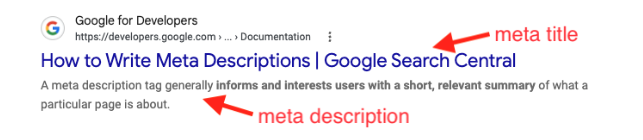
As best practice, your meta title should generally include what the page is about, as well as your target service area, in order to help rank for that keyword in that location. An example would be “Linen Services in Grand Rapids, MI | Near Me”. The meta description should then provide an enticing summary to encourage users to visit the website, like “Grand Linen has been providing quality linen services to Grand Rapids and surrounding areas for over 100 years. Learn more today!” Properly optimizing your meta titles and descriptions is a simple way to improve SEO and AEO visibility.
Schema
Schema is information-rich code hidden on your website. Most schema is not visible to website users, but it is extremely visible to Google and LLMs crawling your pages. Many schema types can be utilized in specific industries.
Types of schema can include:
- Local business schema
- Review schema
- Product schema
- Authoritative/credential schema
- And much more
Leveraging schema relevant to your business can help your website appear in not only organic search results, but in AI overviews and LLM results. For example, if you have a heating and cooling business that depends on maintaining a good reputation, adding review schema to your website will be beneficial. For websites looking to stand out in search results, schema is a must-have.
Technical SEO
Technical SEO ensures that your website pages are easy to read, visible to search engines, properly structured and published, and do not contain major errors.
- Indexing: tells Google (or your preferred search engine) that your webpage should be visible in search results, and asks the search engine to read and scan the page so that it knows when it is relevant to appear in search.
- Readability: helps ensure your website content is easy to understand.
- Alt Text: provides information on the purpose of images or what is being shown in imagery.
- Publishing Transparency: including the publish date of your website posts and pages helps show the relevancy of content, and shows search engines when and how frequently you are adding new content to your website. Having authorship associated with your content also helps build trust and credibility.
- Minimize Errors: ensures your website is free of major errors like 404s (pages not found), and that any pages that have been deleted were properly redirected to the most relevant page. When users have a smooth experience on your website, Google favors it and will be more likely to boost your rankings.
FAQs and Internal Linking
FAQs and internal linking are great ways to add relevant links and content for users on your website while adding SEO and AEO value.
- FAQs, or frequently asked questions, are beneficial to add on service pages of a website. They help give website users valuable information at a glance. FAQs can also be wrapped in schema code, which helps to show in AI overviews, LLM search results, and in the “People also ask” section on Google.
- Internal linking is linking text to another relevant page within your website. Internal links should be relevant to the text they are linked to. For example, you should not link to another service page if you are not directly discussing it within the content. Here are two common examples of good internal linking:
- When discussing company history, add an internal link to the “about” page
- Within a CTA like “To get started, contact our team today,” link to the “contact” page
Proper linking and relevant FAQs can not only help with SEO, but improve the user experience by making relevant links and information easily accessible.
Off-Page SEO
Off-page SEO includes optimizations that are not directly on your website. This includes backlinks, social proof, reviews, business listings, and more. Here are a few of the key elements:
Backlinks and Citations
Backlinks are links on other websites that link back to your website. For example, if a press release article about your business is posted on Yahoo Finance and includes a link back to your website, your website gains a valuable backlink. There are quality and poor backlinks; for example, Yahoo Finance is a website with more reputation and authority than a local blogger in your area. Therefore, the Yahoo Finance backlink is more valuable than the less authoritative backlink.
Similarly, citations include any mentions of a business's name, website, phone number, and address. These typically come from local directories like Yelp, Bing, Facebook, and Apple Maps. Ensuring that your business information is up-to-date and consistent is a great way for both search engines and LLMs to favor your website and show the current business information in search results.
Social Proof
Awards can be useful social proof to help stand out against your competitors. If a user is searching for options, awards proving a strong business will work in their favor. For example, if your business has won “Best in Linen”, flaunt it! Including award and affiliate logos in your website footer is an easy way to make your website stand out.
Reviews
Reviews are key in providing trust for users when searching for a business to meet their needs. Reviews help businesses show in local search results, particularly when it comes to Google My Business. Getting consistent, positive reviews to your profile shows users that your business is trusted and relevant. When it comes to AEO, when users ask an LLM “who is the best…”, one of the first variables in the results is their reputation. LLMs favor businesses that are reliable and trustworthy, and reviews to back that reputation go a long way.
The Importance of Local SEO
How your business appears to your local area matters. Local SEO includes how your business appears on local directories, and optimizing your business listings on various platforms like Google My Business and Apple Maps. ChatGPT and Perplexity favor businesses that have a strong portfolio of positive reviews across platforms like Yelp and Google My Business. Positive, consistent reviews, along with a properly optimized and cited business, show that a company is relevant, trustworthy, and authentic, which are qualities favored in both SEO and AEO.
Start Improving Your AEO Visibility
There is no denying search is changing, and we are entering a time when AI search is becoming more prevalent. Ensuring your website has a strong SEO foundation is a proactive way to set up your site for AEO success by building trust and displaying expertise. While navigating articles and facts about SEO and AEO can be challenging, our team is here to help filter through the buzz and get better results. Contact the team at RED66 Marketing today to start improving your AEO visibility.